
Kimble County Parole Versus Probation
Parole and probation both involve rules in the community, but they start in different places. Parole means a person left a Texas prison before final discharge and remains under TDCJ Parole Division supervision. The Texas Board of Pardons and Paroles makes the release decision. The Parole Division then supervises the person. Those agencies have distinct roles, so a Board decision should not be treated as the name or address of the field office.
Probation, also called community supervision, is imposed by a court. It can let a person serve a sentence in the community or follow a judgment that does not send the person to TDCJ. Kimble felony matters run through the 452nd District Court. Misdemeanor matters commonly remain with the constitutional county court and County Clerk. The signed judgment identifies the community supervision department and is the sound starting record.
| Point | Parole | Probation |
|---|---|---|
| Source | Release from TDCJ confinement | Order in a criminal court judgment |
| Decision maker | Texas Board of Pardons and Paroles | Judge in the filed case |
| Supervisor | TDCJ Parole Division | Community supervision department named by the court |
| Best first record | TDCJ offender detail and parole information | Judgment, docket, and clerk record |
| End point | Certificate or record of discharge | Court or department record showing completion or termination |
Verify Kimble County Post-Release Supervision
Start with the custody history, not a broad name match. A Kimble County Jail release does not automatically create parole. If the person served only a local jail stay, the court file is more useful. If Kimble transferred the person to TDCJ, use the state record. A move from Kimble to Kerr County, TDCJ, federal custody, or ICE is a transfer, not community release.
- Confirm the full name and, when known, date of birth, cause number, SID, or TDCJ number.
- Search the TDCJ Inmate Information Search for a state-prison case. Compare identifiers, county, offense, and sentence before relying on the result.
- Read custody, projected date, parole eligibility, and supervision details together. Eligibility is not release, and approval may still require processing.
- For probation, use the Kimble County District Clerk for felony case records or the County Clerk for the relevant county-court matter.
- Obtain the signed judgment and any later revocation, modification, or discharge order. Note the department named in the papers.
- Contact that office and ask what status information is public. Record the date of the answer because supervision can change.
The broader Kimble County released-inmate search and record guide explains how the jail release entry, court disposition, and receiving-agency record fit together. Use it when the first question is whether the person left custody at all.
Kimble County Parole Records Channels
TDCJ offers more than one route because a web result may be incomplete or may age out after discharge. The public search commonly displays the TDCJ number, SID, name, current location, offense, sentence, projected release date, maximum sentence date, parole eligibility date, and status information. A blank field or “N/A” does not prove discharge. County-jail-only detainees will not appear unless TDCJ received them.
The TDCJ Parole Division is the official supervision agency. The Texas Board of Pardons and Paroles is the decision agency. When a public search lacks the field needed, use the official information or records contact and supply the TDCJ or SID number. For a dated alert on a prison or parole event, the separate TDCJ Integrated Victim Services System is the relevant state channel.
Statewide parole supervision and office verification
Official Parole Division contacts
Texas Board of Pardons and Paroles
Parole review and decision information
Official Board information
The official TDCJ IVSS portal shows how prison and parole notifications are handled.
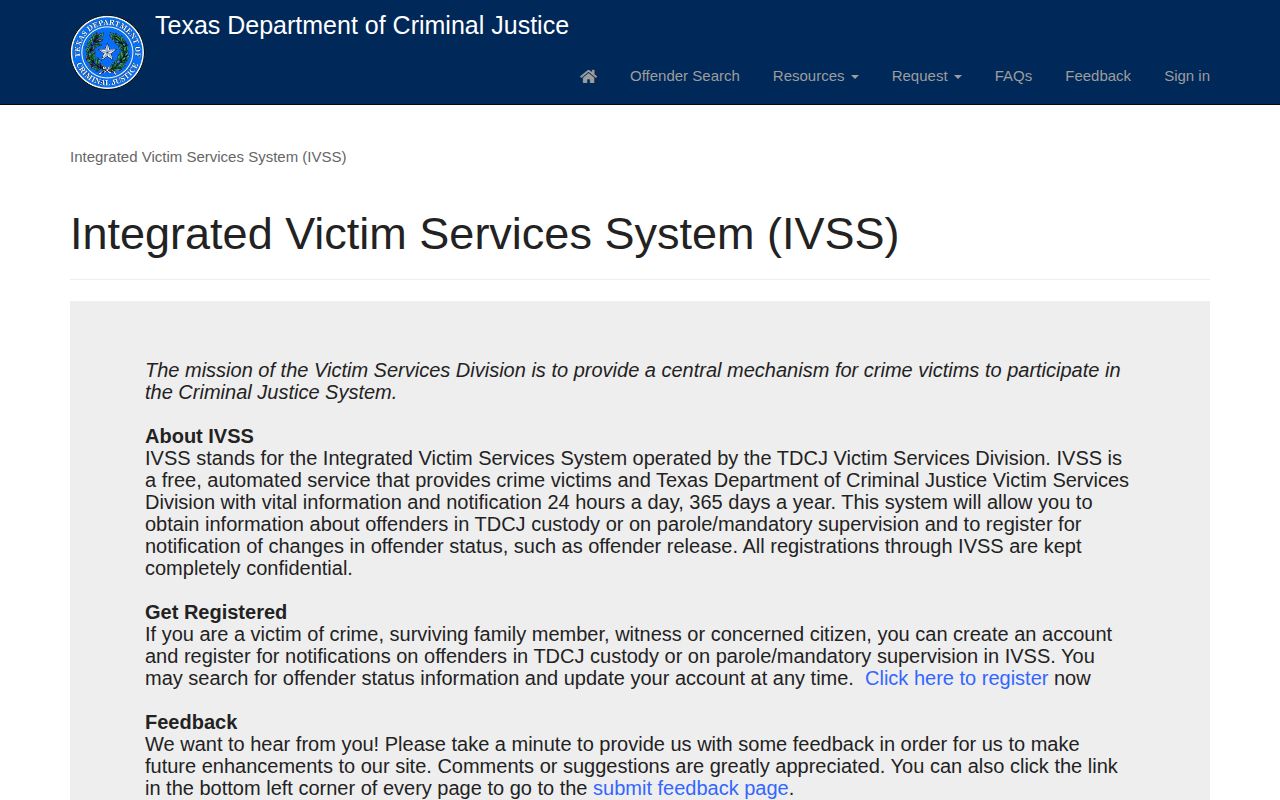
This portal is distinct from county-linked VINELink and should be used for the TDCJ event types it supports.
Kimble County Probation Court Trail
Probation verification rests on the judgment and later docket entries. Both Kimble clerk pages point readers to iDocket, the Tyler Portal, and re:SearchTX. Search spelling variants, then match the cause number and case facts. A docket entry can lead to the judgment, conditions, modification, motion to revoke, or discharge order. It may not reveal every detail that a supervision office can lawfully confirm.
The court record also prevents a common error. A dismissal or bond order in one cause does not show that every other cause or hold has cleared. Likewise, probation in one case does not explain a state parole record in another. Ask the clerk for the signed document when a portal index is terse. Then ask the community supervision department named in that document about the public status and the correct office.
Note: A judgment explains the legal outcome, but the sheriff’s release entry supplies the actual jail departure time and destination.
Kimble County Violations and Absconders
Conditions vary by judgment and supervision plan. They can include reporting, travel limits, program participation, payments ordered by the court, and compliance with other lawful terms. A public page cannot establish whether a person met each condition. The filed order and supervising office control. If a condition changes, use the later written order rather than an older summary.
An absconder label means the agency alleges that the person failed to stay in contact or follow supervision. It is not a new conviction. A violation report may lead to a warrant, hearing, revocation, added conditions, or no final adverse finding. Verify any warrant through the issuing court or law-enforcement agency. Do not infer warrant status from silence in VINE, because VINE is a custody notification service, not a complete supervision warrant index.
A parolee can leave prison yet remain subject to a detainer, warrant, or approved-release-plan requirement. Parole approval alone does not promise immediate pickup. Confirm the scheduled release information with TDCJ, then distinguish release to supervision from transfer to another custodian.
Kimble County VINE and IVSS
The Kimble County Sheriff links directly to Texas VINELink for custody checks. That is useful when a local jail event may involve release or transfer. It does not replace the release log, and it does not identify the probation office. When a VINE result says released, ask the sheriff whether the destination was the community, Kerr County, TDCJ, federal custody, or ICE.
TDCJ IVSS serves a different layer. It handles supported prison and parole notification events. A person can have a TDCJ supervision record after leaving prison, while a probationer whose case never entered TDCJ is traced through the court and community supervision department. Choose the channel from the custody history rather than assuming one notification system covers all cases.
Ending Kimble County Supervision
Supervision ends through a formal record, not merely the passage of a projected date. For parole, seek TDCJ information showing discharge or the end of the supervision term. For probation, seek the court or department record showing completion, early termination, revocation, or another disposition. “Released” and “discharged” are not synonyms. Release marks departure from confinement; discharge marks the end of the corrections or supervision obligation described by the record.
Texas Government Code chapter 508 governs major parts of parole and mandatory supervision. Public records remain subject to Government Code chapter 552 and its exceptions. If a public result disappears, contact the record custodian. A missing web result may reflect retention limits, restricted material, spelling, or an older discharged record. It does not prove that supervision never existed.
Keep a copy of the judgment, release entry, and final discharge record when the distinction matters for personal knowledge or a court process. Each document answers a different question and supplies a date tied to its own event.