
Kimble County TDCJ Custody Path
A Kimble County detainee transported to TDCJ remains confined. The Kimble release or transfer entry should name TDCJ as the receiving system and give a timestamp. After state intake, TDCJ becomes the controlling source for location, sentence fields, projected dates, parole status, and eventual discharge.
A later exit may lead to parole or mandatory supervision in the community, another custodian, or full discharge. Parole means prison confinement ended while the sentence continues under conditions. Discharge generally marks the end of TDCJ sentence or supervision involvement. Another jurisdiction may still have authority, so identify the event and destination instead of relying on the word “released” alone.
Search TDCJ Kimble County Records
Open the TDCJ Inmate Information Search. A seven-digit TDCJ number gives the strongest match, followed by the Texas SID. With a name, enter the last name and at least the first initial, then use age, sex, or race only to distinguish candidates.
- Search with the strongest unique number available.
- Open a candidate only after matching name and identifiers.
- Compare the offense, conviction county, case, sentence, and current unit.
- Read projected release, maximum sentence, parole eligibility, and status together.
- Request the official release or discharge record when exact proof is needed.
The statewide result does not cover a county-jail-only stay. If Kimble never transferred the person into TDCJ, use the Sheriff’s booking and release record instead. The broader Kimble County released-inmate search explains that custody ladder.
TDCJ Release Search Fields
The exact public fields vary by record. A blank field or “N/A” should not be converted into an event. The following items commonly help verify identity and status.
| Field | What it means |
|---|---|
| TDCJ number or SID | Unique state identifiers for matching. |
| Current unit or location | The reported state placement when confined. |
| Projected release date | An estimate that can change, not proof of exit. |
| Maximum sentence date | A separate sentence endpoint. |
| Parole eligibility date | When review may begin, not promised release. |
| Offense, county, and case | Links the state record to the judgment. |
| Status or supervision | May distinguish confinement, parole, or discharge. |
TDCJ public web data is not a lifetime archive. Some discharged records may age out of the public result. Use the email lookup, formal records process, and sentencing court when the web search does not find an older state record.
TDCJ Projected and Actual Release
A projected date is calculated from the sentence structure, credits, legal eligibility, detainers, and other case facts. It can move after disciplinary action, new sentence information, a credit change, parole action, or recalculation. TDCJ also warns that a scheduled release date can change on the scheduled day.
For qualifying offenses committed before September 1, 1996, a projected date may relate to mandatory supervision if parole does not occur. For later offenses, discretionary mandatory supervision depends on Board review when the person is eligible. If release is denied or the person is excluded, the projected date may instead indicate the discharge endpoint. The offense date and statute matter.
TDCJ Good-Time Release Limits
Texas Government Code chapter 498 states that good-conduct time affects eligibility for parole or mandatory supervision and does not otherwise reduce the sentence. It is a privilege rather than a right, and classification, program participation, and forfeiture can affect it.
Government Code chapter 508 contains several eligibility formulas and exclusions. Texas has no universal rule that all prisoners serve 85 percent. Eligibility also is not release. The proper sequence is offense date, conviction statute, judgment findings, sentence structure, TDCJ date fields, and the applicable law.
- Parole
- Conditional release from prison confinement while the sentence continues.
- Mandatory supervision
- A statutory release form subject to eligibility and, for many cases, Board review.
- Projected date
- A changeable calculation, not a completed exit.
- Discharge
- The end of the controlling TDCJ sentence or supervision involvement.
TDCJ Release Records and Contact
The official TDCJ email lookup instructions say to send the full name and seven-digit TDCJ number to pia@tdcj.texas.gov. If the number is unknown, give an exact birth date or approximate age and county of conviction. The basic service may return the number, location, offense, incarceration history, conviction county and court, and projected release date without a fee. It does not provide photographs through that route.
Public Information Request
PO Box 4017
Huntsville, TX 77342
Email: PIA@tdcj.texas.gov
Hand delivery: 2 Financial Plaza, Suite 600, Huntsville
Use the TDCJ open-records process for a release or discharge record. Provide the TDCJ number, date range, and wanted fields, including release date, type, destination, and supervision status. Ask for electronic delivery and an estimate. A public search result is useful evidence but not a certified discharge packet.
TDCJ Parole and IVSS Notices
The Texas Board of Pardons and Paroles decides release matters. The TDCJ Parole Division supervises people after release. Those are separate roles. Approval can still require program completion, plan approval, certificates, and processing before a prison exit occurs.
TDCJ Victim Services operates the Integrated Victim Services System for people in TDCJ institutions or under Parole Division supervision. IVSS can communicate parole review, release to supervision, discharge, and supervision-warrant events. It differs from Texas VINELink, which Kimble County promotes for county custody.
When a Kimble detainee transfers into TDCJ, the relevant notification layer changes with the custodian. Neither VINE nor IVSS is a certified release certificate. Confirm the event through the state record.
View TDCJ Search Evidence
The official TDCJ search form shows the identifiers and name fields used for a statewide lookup.
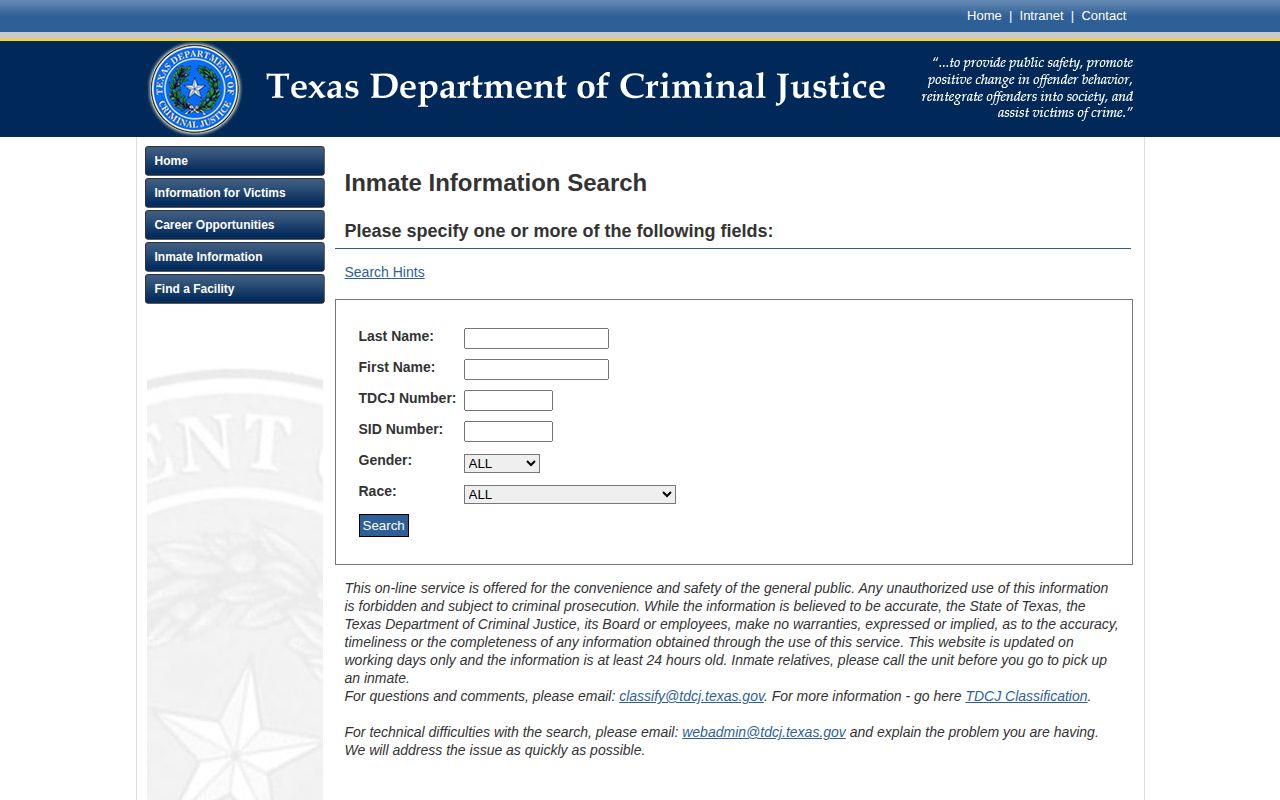
The interface supports state-record matching. It should not be used to infer a Kimble County jail release when TDCJ never received the person.
Match Kimble and TDCJ Numbers
Keep the Kimble booking number, county cause number, and TDCJ number together. Each identifies a different part of the record chain. The booking number anchors the county jail stay. The cause number anchors the judgment. The TDCJ number anchors state incarceration and supervision. Matching all three prevents a transfer date from being confused with a prison release date.
If a state result conflicts with the Kimble judgment, compare sentence dates, county, case number, and identifiers before seeking correction. Ask the agency that owns the field to review it. The Sheriff cannot correct TDCJ sentence data, and TDCJ cannot revise a county court docket.
No TDCJ Unit in Kimble
No TDCJ prison or state jail was identified in Kimble County. A unit address shown in a state result is the actual facility contact. Use the current TDCJ directory because unit and parole-office assignments can change.
Family pickup should be confirmed with the named facility after a scheduled release location appears. A screenshot is not permission to arrive at a gate, and local Kimble jail logistics do not govern a distant TDCJ unit.
Public Record Search
Sponsored Results