
Kimble County Scheduled Versus Actual Release
A scheduled or projected release date is a calculation based on the information in the record at that time. It may reflect the sentence, credited confinement, eligibility rules, disciplinary history, and other legal events. An actual release date records a completed departure. The two can match, but they answer different questions.
A pretrial detainee usually has no sentence-based release date. A bond decision, dismissal, or court order can authorize release, yet booking staff must still clear other causes, warrants, detainers, and paperwork. The Kimble County Sheriff’s Office must confirm whether the event became community release or a transfer. A person moved to Kerr County or TDCJ remains confined.
For a county sentence, obtain the judgment and jail-credit finding, then ask the sheriff for its computation. For a state sentence, use TDCJ’s calculated fields. Do not apply one system’s rules to the other.
Find Kimble County Projected Release Dates
The strongest route follows custody. Start with a precise identifier and ask what agency now holds the person. Kimble’s official sheriff page has no public roster, so a failed web search is not evidence of release.
- Call the Kimble County Sheriff at 325-446-2766. Ask whether the person is held, released to the community, or transferred, and request the destination.
- For a Kimble sentence, obtain the judgment, cause number, sentence, and credited-days finding from the appropriate clerk.
- Ask the jail for its current computation and, after departure, the release entry with actual date, time, type, and destination.
- For a state sentence, search the TDCJ Inmate Information Search by TDCJ number, SID, or name.
- Open the detail and compare identifiers, offense county, cause, sentence, location, and status before reading any date.
- If the public record is absent or old, use TDCJ’s official information or records contact and provide the SID or TDCJ number.
The Kimble County release-record guide explains the wider custody ladder, including court, Kerr County, federal, and ICE checks.
Kimble County TDCJ Date Fields
TDCJ separates three fields that are often confused. The projected release date is the current calculated estimate. The maximum sentence date is the computed sentence endpoint absent a legally earlier release, subject to sentence structure and corrections. The parole eligibility date marks when the case may first be considered under the governing law. Eligibility does not order or predict release.
| Field | What it means |
|---|---|
| Projected Release Date | TDCJ’s current estimate from sentence and credit data |
| Maximum Sentence Date | Computed sentence endpoint, distinct from an earlier lawful release |
| Parole Eligibility Date | First possible review date under the applicable rule, not a promise |
| Status and location | Current record context needed before interpreting dates |
| Offense, county, and case | Identity and sentence checks that prevent a false match |
A blank or “N/A” field does not prove release. TDCJ’s public data is not a lifetime archive, and a Kimble jail-only stay will not appear unless the person entered TDCJ.
The official TDCJ search form shows the identifiers accepted for lookup.
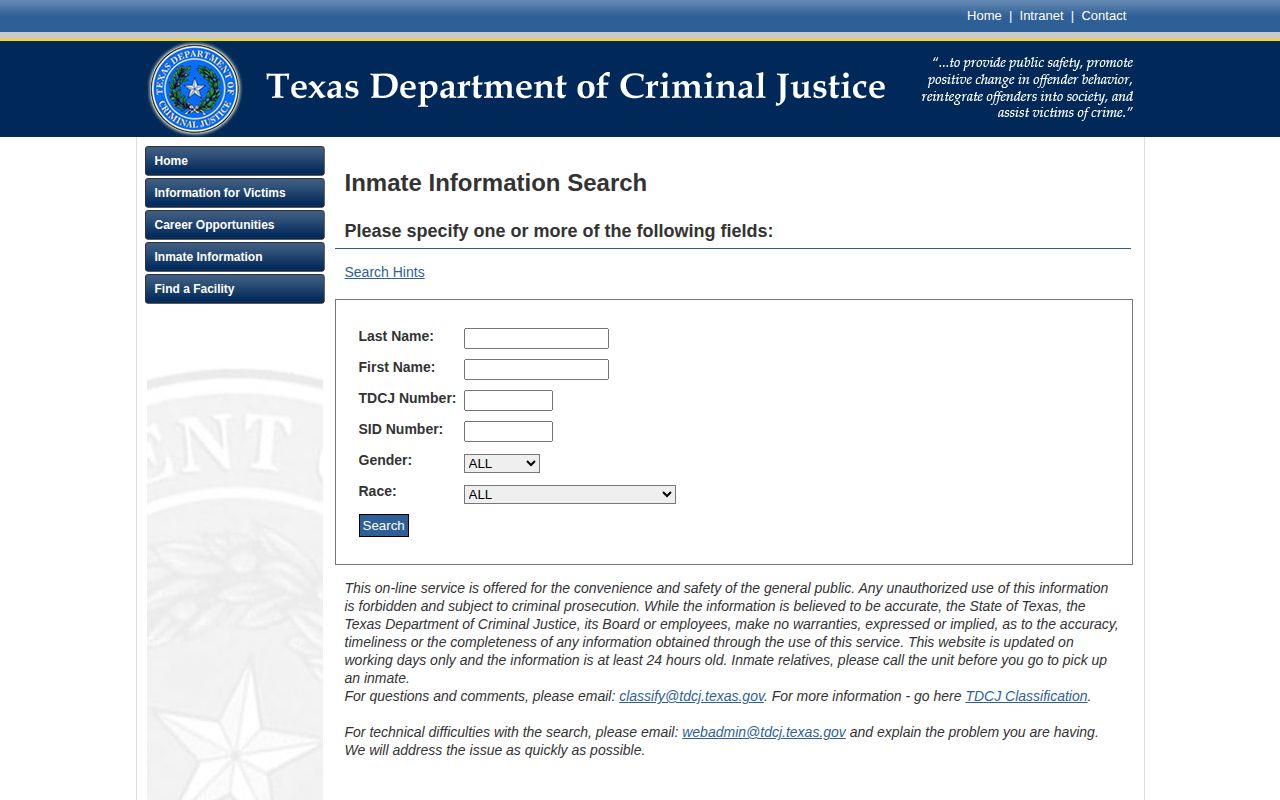
Use the strongest identifier available, then open the detail rather than treating a name-only result as conclusive.
Texas Time Credits and Eligibility
Texas good-conduct time is not a flat number of days subtracted from every sentence. Government Code chapter 498 governs classifications and good-conduct time. Chapter 508 governs parole and mandatory supervision. Credits can affect eligibility and projected timing in different ways based on the offense date, offense type, sentence, disciplinary status, and mandatory-supervision eligibility. Good time is not a vested right to an early door-out date and can be forfeited.
The familiar “85 percent” phrase is unsafe as a statewide shortcut. Texas does not require every prisoner to serve exactly that share. For cases governed by Government Code §508.145(d), parole eligibility generally uses actual calendar time equal to one-half of the sentence or thirty calendar years, whichever is less, with the statutory minimum. Other subsections use different rules or exclusions. The offense and statute must be matched before calculating.
Mandatory supervision under §§508.147 through 508.149 is also conditional. Actual time plus eligible accrued credits can matter, but exclusions and discretionary review can control. The public TDCJ field is the sound current computation. The judgment and offense date explain why it has that value.
Why Kimble County Release Dates Move
A date can change before release because the facts or legal basis used in the computation change. Read the full record and note the date on which the estimate was checked.
| Change | Possible effect | Where to verify |
|---|---|---|
| Jail-credit correction | Moves the credited start or remaining term | Judgment, credited-days finding, records office |
| Disciplinary credit loss or restoration | Changes eligible credit and projected timing | TDCJ classification and records |
| Concurrent or consecutive sentence ruling | Changes how multiple terms combine | Judgment and corrections computation |
| New case, warrant, or detainer | May prevent community release at the first term’s end | Holding agency, court, receiving custodian |
| Parole decision | May permit supervised release or keep the person confined | Board decision and TDCJ status |
| Mandatory-supervision review | May affect an eligible projected release | TDCJ and Board records |
| Administrative recalculation | Corrects data used in the displayed estimate | TDCJ information channel |
Parole approval can still require a release plan, programs, certificates, and processing. The approved date should not be treated as a pickup promise.
No Kimble County Good-Time Table
No official Kimble source in the research sweep published a county jail good-time table, a fixed release hour, or a weekend or holiday early-release rule. That absence matters. A reader cannot safely subtract a generic credit rate from a county sentence or assume that a date falling on a weekend moves to another day.
Obtain four linked records instead: the court judgment, the credited-days finding, the jail’s written computation, and the actual release entry. Ask the sheriff whether another hold or transfer applies. Texas statutes provide the legal framework, but a local policy must not be invented from statewide prison practice.
The sheriff page reports daily magistrate court, but a bond ruling does not fix the time booking staff will complete release. Court authorization and physical release remain separate events.
A narrow records question helps preserve that distinction. Ask the jail for the existing sentence computation showing credited confinement and the expected end date, if maintained. Then ask whether the calculation has been changed by another cause, warrant, detainer, or transfer order. Staff may explain current operations by phone, but a written computation and later release entry provide a better dated trail.
Kimble court records add the legal basis. The County Clerk and District Clerk both point to iDocket, the Tyler Portal, and re:SearchTX. Match the cause number before using a judgment. A sentence length in the docket does not reveal all credit or the actual door-out time, so link it to the sheriff record rather than doing arithmetic from the docket alone.
Kimble County Transfer Date Traps
A date beside departure from Kimble custody may record a transfer rather than a release to the community. County materials describe Kerr County handling or holding Kimble prisoners and transport into TDCJ. Ask for the destination or receiving agency every time. If Kerr received the person, verify present status with Kerr. If TDCJ received the person, the state projected-date fields become relevant only after that intake.
The same caution applies to federal and immigration holds. BOP and ICE maintain separate locator systems, and neither a Kimble departure nor silence in TDCJ establishes community release. The record should name the event precisely: release on bond, sentence completion, parole, or transfer to a named custodian.
Confirm Kimble County Release Timing
Close to the expected date, check the controlling agency again. For TDCJ, read the date beside present status and location. The official scheduled-release guidance explains that release information may change.
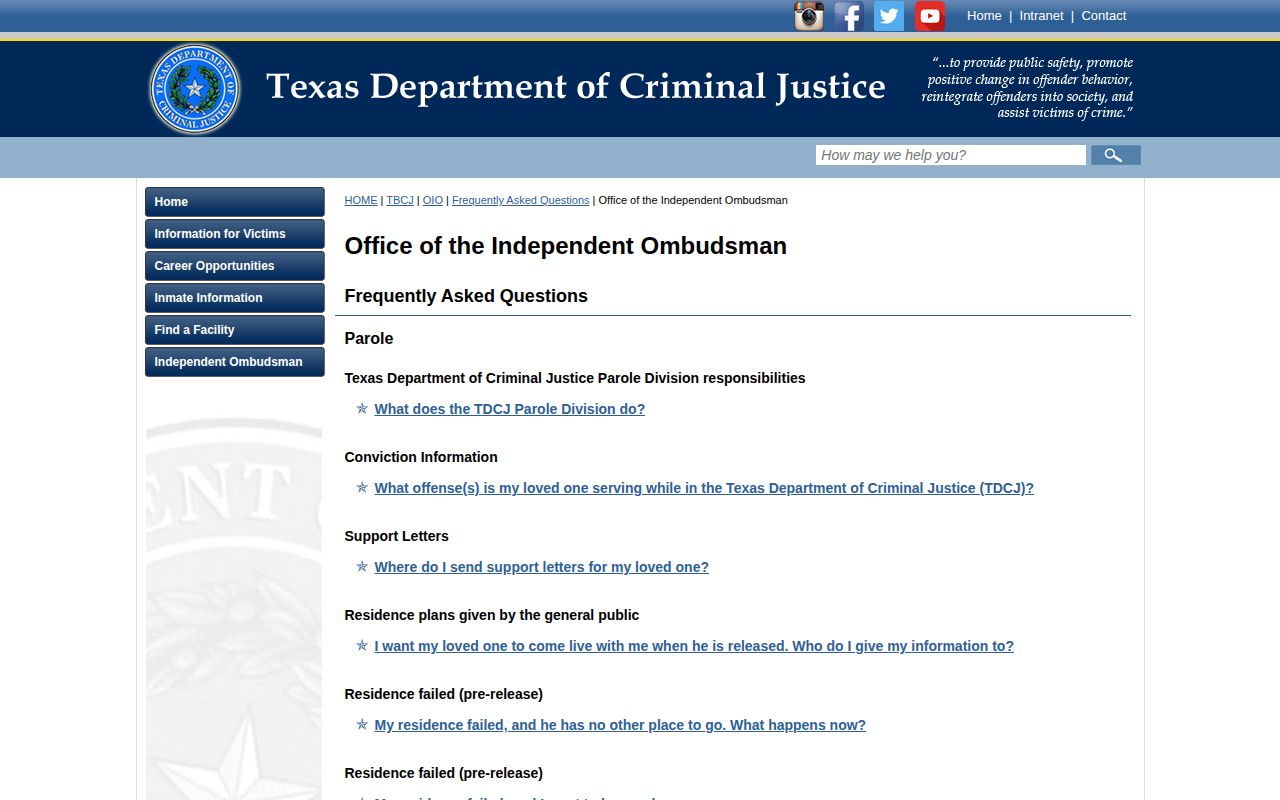
The agency warning is why a saved projected-date screenshot should be timestamped and later compared with the completed release record.
For Kimble custody, call the jail and request the release destination. Use the Kimble County VINE inmate check for a supported custody-change alert, but do not treat the alert as a certified historical record. A facility-level release can be a transfer.
After the event, request the existing release log entry. Ask for the name, booking number, actual release date and time, release type, and destination or receiving agency. That record resolves whether the projected event became community release, parole, transfer, or continued custody elsewhere.