
Kimble County VINE Coverage
Kimble County gives VINE unusual local importance. The official Sheriff’s Office page does not host a public inmate roster or recent-release archive. Instead, it explicitly directs visitors to VINELink to check offender custody status. That makes Texas VINE the county-endorsed online starting point for a named custody check.
VINE stands for Victim Information and Notification Everyday. It is a notification and status service fed by participating agencies. It is not the sheriff’s certified release log, a court docket, or a complete historical archive. Coverage and update speed depend on the agency feed. If the person was moved from Kimble to Kerr County, TDCJ, or another participating jail, the record may reflect a custody event without explaining the full local booking history.
Texas also has TDCJ Integrated Victim Services System for supported prison and parole events. That portal is distinct from county-linked VINELink. Federal BOP and ICE custody require their own locators.
Search Kimble County Inmates on VINE
Gather the person’s full name, date of birth if known, and an offender or booking identifier when available. A precise identifier reduces false matches. Search one state and agency context at a time.
- Open the official Texas VINELink page.
- Select Texas and choose the person or offender search presented by the current interface.
- Enter the full name or offender ID. Try a careful spelling variant only when the first search fails.
- Review all matches. Compare any available age, sex, agency, location, or identifier before opening a record.
- Read status and location together. “Released” at one facility can describe a transfer to another custodian.
- Save the record or confirmation details needed to manage an alert, but recheck the agency when the event occurs.
If no match appears, do not conclude that the person was released. The name may differ, the feed may lag, or the agency may not participate. Call the Kimble County Sheriff at 325-446-2766 and ask whether the person is held, released to the community, or transferred.
The Kimble County released-inmate guide provides the full fallback ladder when VINE does not resolve the question.
What Kimble County VINE Shows
The exact record fields can vary by agency and interface. Treat each displayed field as a lead tied to the supplying agency, not a substitute for that agency’s record.
| Field | What it shows |
|---|---|
| Name or offender ID | The identity key used for the participating custody record |
| Custody status | The latest status supplied to VINE, subject to processing lag |
| Facility or location | The agency or place reported by the feed, when available |
| Custody event | A supported release, transfer, or other change |
| Notification options | The delivery methods and events currently offered for that record |
| Registration details | Information used to confirm or manage the notification request |
A VINE “released” or “out of custody” event is a fast notification lead. It does not necessarily state the actual door-out time, legal reason, or destination. Ask Kimble for the release entry when those facts matter. A county release to Kerr County, TDCJ, federal custody, ICE, or a guarded medical setting is not community freedom.
Kimble County VINE Search Screen
The live Texas VINELink interface is the manifest-approved source for the search and notification workflow.
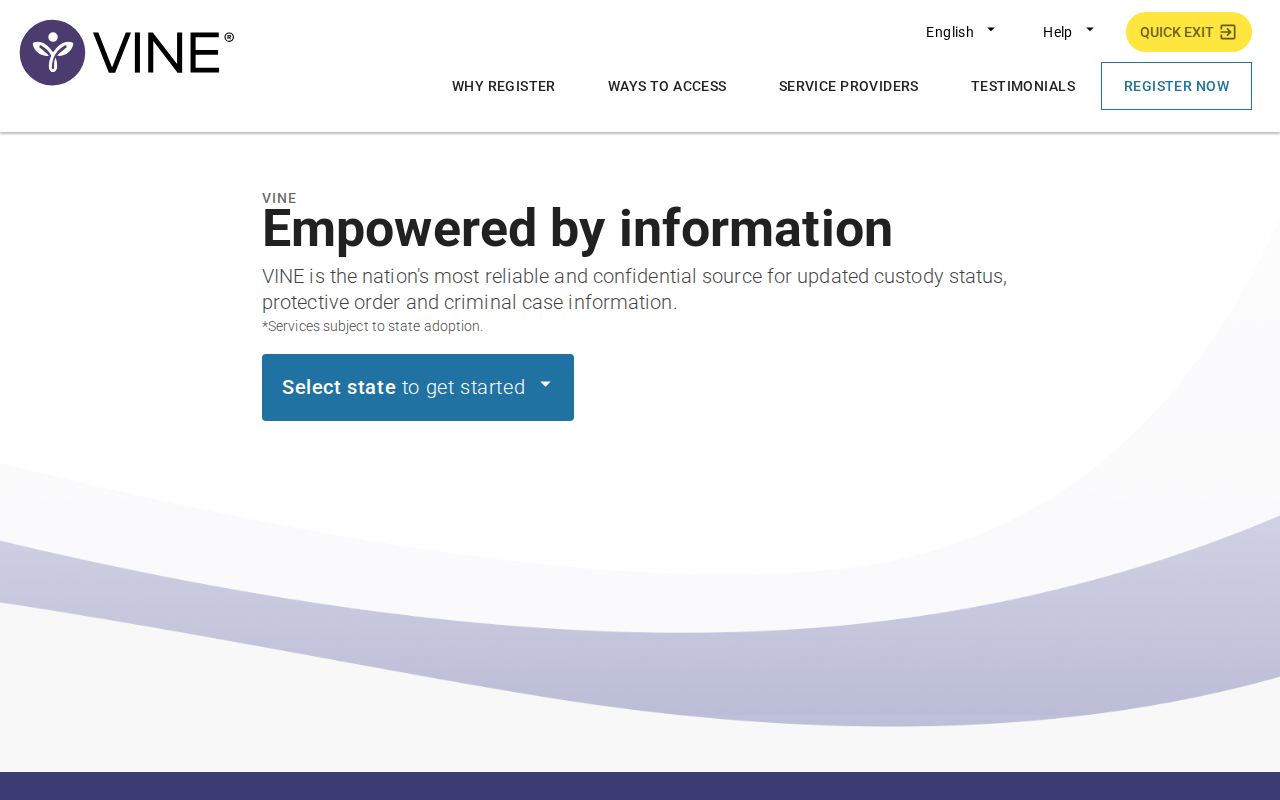
The interface can change, so follow its current prompts rather than relying on an old fixed list of buttons or delivery methods.
When several people have similar names, stop and compare the identifiers displayed. A name match alone is not identity proof. If the interface lacks enough detail, ask the supplying agency to confirm the booking or offender number before registering against the record.
Register Kimble County Release Alerts
Registration begins from the correct person’s result. Select only the custody events useful for personal notice or safety planning. Available delivery choices can include telephone, email, or text, but the current interface controls what is offered.
- Open the verified person record and choose the notification option.
- Select the custody event or events shown, such as release or transfer.
- Choose an available delivery method and enter the contact information carefully.
- Confirm the address or number when prompted.
- Create or enter any PIN requested for telephone notices. Use one that can be recalled but not easily guessed.
- Finish the verification step and keep the confirmation needed to return to or manage registration.
- When an alert arrives, contact the supplying agency and request the event’s reason and destination.
A telephone notice may ask for the PIN to acknowledge receipt. An unacknowledged call may repeat according to the service’s current process. Do not share a PIN with someone who should not manage the registration.
VINE should not be the sole plan for an urgent safety concern. Call emergency services in an emergency, and use the appropriate agency contact for current operational information.
Kimble Sheriff Endorses VINELink
Kimble follows a distinctive local practice: the sheriff points directly to VINELink instead of offering a county-built roster. This is more than a generic state option. It is the local office’s published online direction for offender custody status.
That endorsement still has a clear boundary. VINE does not create Kimble’s historical release record. When a notification says a person was released, call the Sheriff’s Office and request the completed release entry with date, time, type, and destination. If the event was a transfer, ask for the receiving agency. This is vital in Kimble because county materials document a role for Kerr County in handling or holding Kimble prisoners.
The distinction prevents two common errors: treating disappearance from a display as proof of release, and treating release from one facility as proof that the person went home. A custody chain can continue across agencies.
Kimble County VINE Limits
VINE is not a federal inmate locator. For a federal Bureau of Prisons case, search the official BOP locator. “Not in BOP custody” can still include another custodian, so compare the result with the federal docket or holding agency. ICE’s Online Detainee Locator is separate, and no ICE match does not prove release.
VINE data can lag booking and release processing. It may not preserve the historical detail needed later. A missing record can result from spelling, agency scope, feed timing, or retention. The Kimble Sheriff’s phone check and a narrow Texas Public Information Act request are the local fallback. Ask for the existing booking and release record, not a newly created explanation.
For a state prisoner, use the TDCJ offender search as well. It can display identifiers, location, projected release date, maximum sentence date, parole eligibility date, offense data, and status. A future projected date is not actual release, and county-jail-only detainees do not appear unless TDCJ received them.
Confirm Kimble County VINE Results
Match the confirmation route to the event. For a Kimble jail result, call the sheriff and ask for current status plus the release or transfer destination. For a TDCJ event, compare the offender detail and contact the corrections information channel if the public result is unclear. For probation, use the court judgment and the community supervision office, because VINE does not serve as a probation status index.
After a local event, submit a narrow written request when durable proof is needed. Identify the person and booking date, then request the booking number, actual release date and time, release type or reason, and destination or receiving agency. The jail record supplies facts the alert may omit.
Keep the VINE confirmation with the agency response, noting when each was obtained. That record trail shows what the service reported and what the custodian later confirmed. It is much stronger than an unsupported claim based on a vanished name or a single old screenshot.